


We began our sustainability journey with help from EcoMerit in 2018. A comprehensive review of our environmental performance and practices was followed by the creation of our very first improvement plan and EcoMerit certification in 2019. Since then, we have never looked back!

Donegal Airport recognises the importance of urgent action to reduce greenhouse gas emissions and improve energy efficiency to address the increasing threats of climate change. Measures to reduce greenhouse gas emissions will require rapid, far-reaching and unprecedented changes from Donegal Airport both in the short-term and over the next decades.

Every year we review progress on our plan and set ourselves new improvement actions. Real, measurable environmental action has never been more important, and we are determined to play our part in full. The above figures show our progress at the most recent review with EcoMerit in 2026..
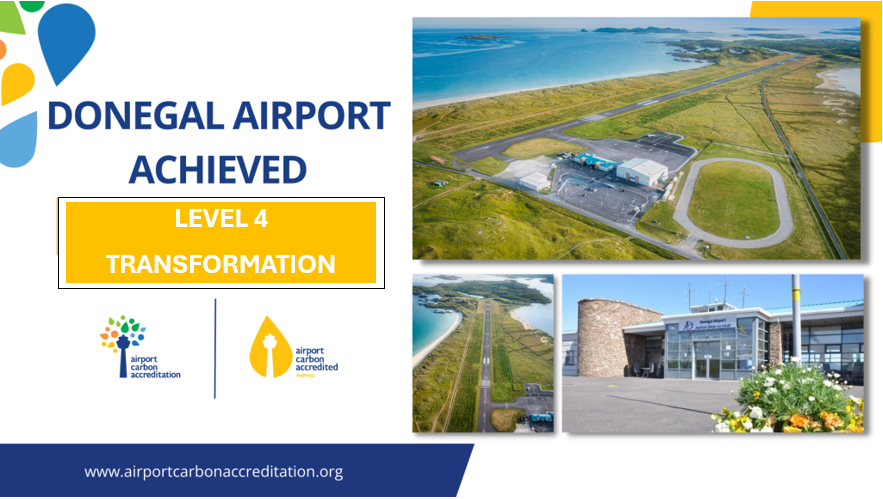
In addition to being EcoMerit certified, we have also joined the Global Airport Carbon Accreditation (ACA) scheme and were the first Irish airport to achieve level 4 (Transformation) in 2024.
The EcoMerit Environmental Management System (EMS) tools including our annual performance workbook have proven invaluable in verifying our carbon footprint, energy & water consumption as well as waste creation totals.
Notable Achievements
Our performance improvement over the years is the result of many actions, often small and simple in themselves, and all requiring the support of our staff. Some of our most impactful actions include:

- 1.5km runway lighting converted to LED.
- Internal and external lighting converted to LED lighting, set to motion sensors for reduced usage and timed where necessary.
- Rainwater harvesting tank used for water consumption by RFFS training and airport maintenance.
- Solar panels installed in 2023 & 2025 and power stored for Airport usage.
- Electric vehicles added to ground fleet (Tow tugs, baggage trolley) with more anticipated in the coming year. Future vehicle purchases will also have environmental impact considered.
- Upgraded terminal building roof and installed mechanical ventilation system with heat recovery.
- Using a heat pump for hot water requirements.
Our Carbon Footprint
One of our key performance measures is our carbon footprint.
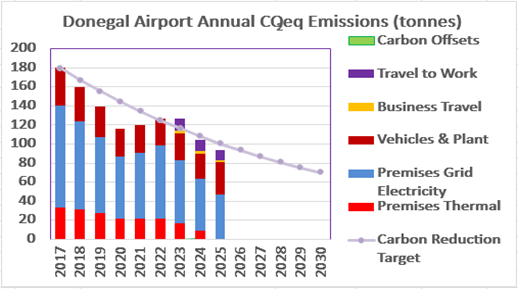
All figures verified in 2026 by EcoMerit.
EcoMerit members’ carbon footprint must include Scope 1 and Scope 2 emissions as defined by the Greenhouse Gas Protocol.
We decided to use our 2017 emissions as a benchmark for reductions and set ourselves the target of a 7% footprint reduction each year (indicated by the trend lines above). This is in line with the targets set by the Paris Accord for global reduction in Greenhouse Gases. As can be seen in the charts above, we are doing rather well so far and are on target, even whilst also starting to include some Scope 3 (value chain) emissions including business travel and staff travel to work into the footprint calculations!
 Client Quote:
EcoMerit have provided us with an excellent service since we joined in 2017. Their support and guidance has been instrumental in our achievements to date and we look forward to continuing working with them to achieve our long term goal of Net Zero by 2050.
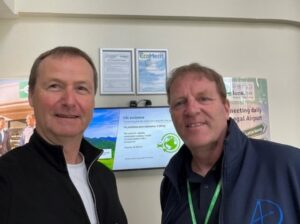
From left to right: Christian Kubernat (EcoMerit Director) and Breandán Ó Baoill (Air Traffic Controller at Donegal Airport) during the 2024 EcoMerit annual surveillance site visit.
The Journey Continues
While we are proud of our achievements to date, we know there will always be more to do. It is our responsibility to play our full part in averting the worst effects of the climate and bio-diversity crises.
In the coming years we will:
- Continue to upgrade our Ground Support Equipment and vehicles to EVs.
- Install sensors to control urinal flushing.
- Upgrade departure lounge heating system.
- Explore other options for electricity generation onsite such as Wind turbines.
Our longer-term ambitions include:
- Finding a reliable means of measuring the carbon footprint of additional Scope 3 emissions associated with our activities.
- Net Zero emissions no later than 2050, in line with the Government’s Climate Action and Low Carbon Development (Amendment) Act 2021.
- Offset non-avoidable emissions.
We are proud to be a member of the EcoMerit Community. Our partnership with EcoMerit helps guide us on our sustainability journey and gives us independent verification of our achievements to date.